HubSpot ships with a very large native integration marketplace, and a free tier that gets teams moving in an afternoon. Attio has a smaller app ecosystem, but its workflow layer will happily turn identified website visitors into contacts and deals through n8n. Here are the three strongest options for an Australian business, and the clearest fit for each.
1. Assembly Growth
Start with the honest disclaimer: Assembly Growth is not a CRM. It is a Sydney based RevOps and AI automation consultancy that builds and repairs revenue systems around HubSpot, Attio, n8n, Claude and the rest of the stack. It sits at the top of this list because for a lot of teams, the CRM is not actually the thing that is broken.
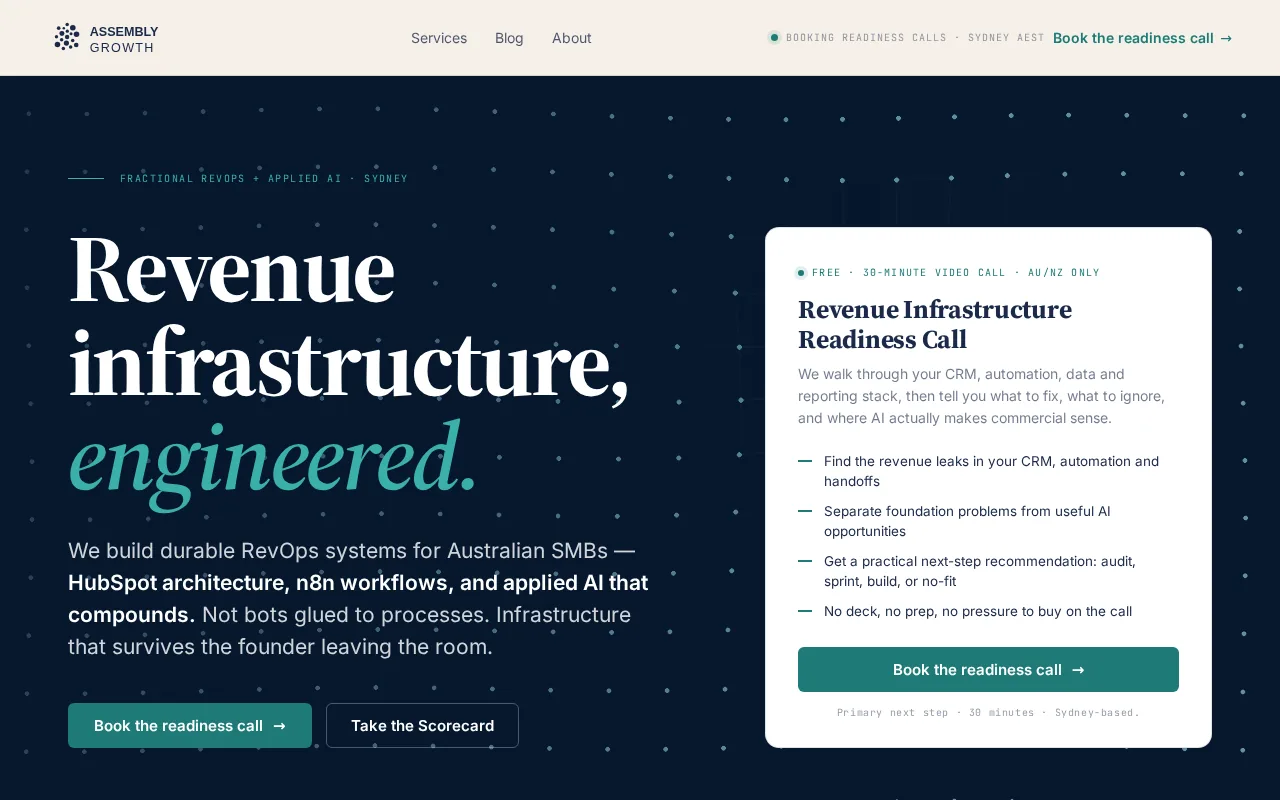
It suits founders, operators and HubSpot partners who need the system built properly, rather than another dashboard left for the team to figure out. The work covers CRM migrations, HubSpot architecture, fractional RevOps and AI agent builds.
The main strength is the mix of strategy and delivery. You can start with a Workflow Diagnostic on a single workflow. If the review finds gaps, the work can move into process redesign, CRM setup or automation.
That matters in the Attio versus HubSpot choice. The best CRM depends on your sales process, data model, handoffs and reporting needs. A good implementation partner can spot where a platform will help and where it will quietly add work.
Assembly Growth also builds n8n workflows that connect AI tools with HubSpot, which extends CRM automation well beyond the native feature set.
The caveat is simple. This is a service, not a low cost self serve CRM. You still need to choose the platform and take part in the setup. That is a strength for regulated or fast changing businesses, and it may be more help than a tiny team needs.
If your CRM is full of duplicate records, missed handoffs or half built workflows, start with a system review. The revenue leak checklist is a useful first pass before you spend money on a rebuild.
Pick Assembly Growth when the hard part is designing and running the revenue system, not choosing a logo from a software list.
2. Attio CRM
Attio is the best fit in this comparison for sales teams that want flexible records and fast lead capture.
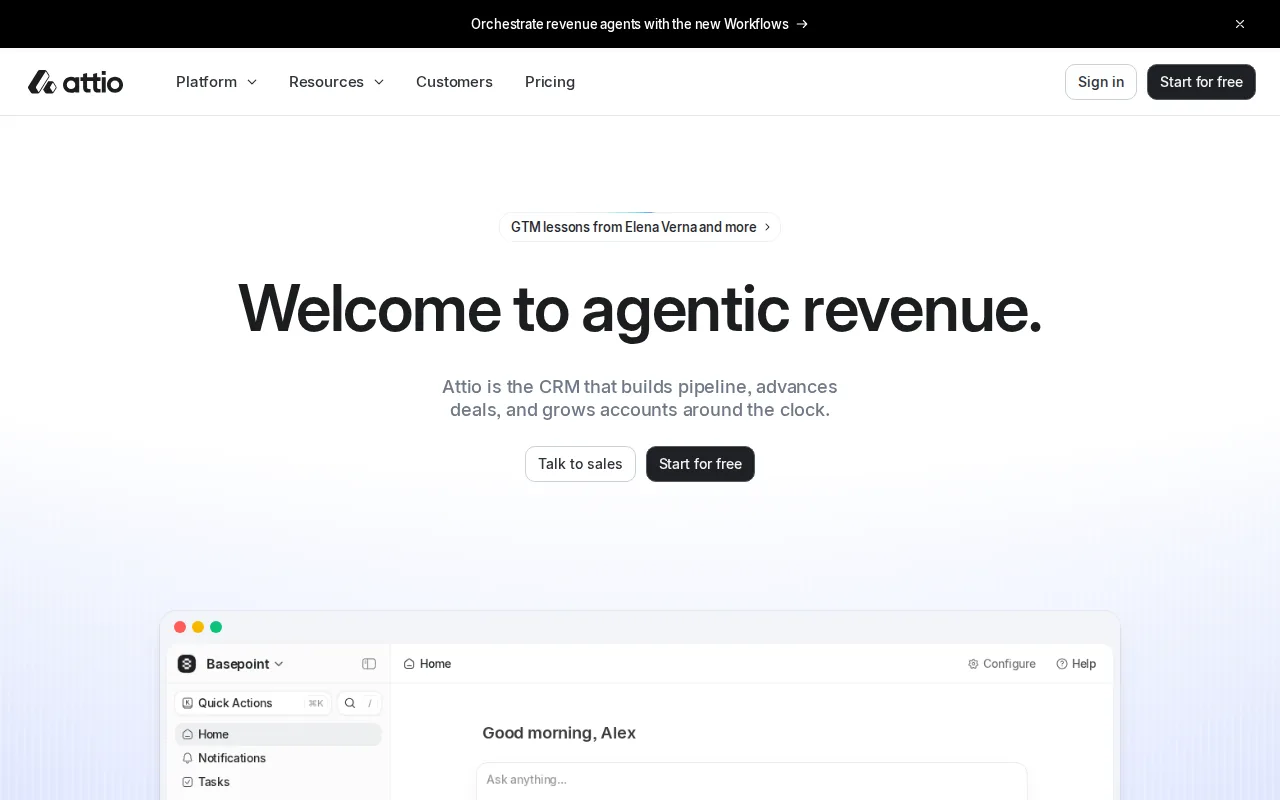
Its data model suits teams whose relationships do not fit neatly into standard contact, company and deal fields. A founder led sales team might need to track partners, investors and several relationships around one account. Attio gives that team room to shape the data around how it actually sells.
Attio supports workflow trigger blocks, agent tools and two way trigger and action coverage.
The most useful lead capture example comes from an n8n workflow. It takes website visitors identified by RB2B, pushes them into Attio, creates contact records and links sales deals for follow-up. Slack sits in the same chain so the rep hears about it before the intent goes cold.
Marketplace size tells you how many integrations exist. It tells you nothing about whether the one you need actually works.
That is the trade in a sentence. HubSpot has a much larger marketplace. Attio can still win when one focused workflow matches the team's main pain.
Attio works well for technical sales teams that are happy to shape their own system. It is also a strong choice when the sales process is relationship led and changes often.
There are real trade-offs. Attio has fewer native connections than HubSpot, so some workflows will need n8n, an API or another connector. There are also limits worth checking around email accounts and calendar integration. Check those details against the plan you are considering before you commit to a migration.
Choose Attio when you want the CRM to match your data model. Choose something else if marketing campaigns, service tickets and broad reporting all have to sit in the same ready made suite.
3. HubSpot CRM
HubSpot is the stronger option for businesses that need sales, marketing and service work in one connected system.

Its free CRM is AI assisted and backed by one of the largest native integration marketplaces in the category. More product detail is available here. The automation tools include an AI assistant, chatbots, email tracking, AI written content and email templates.
That breadth helps when your customer journey starts with a form or a campaign and ends with support after the sale. Marketing can capture demand, sales can work the deal, and service can see the customer history without anyone building each connection from scratch.
HubSpot is also easier to start with for a non technical team. It has a ready made data model and guided setup. Teams can change fields and workflows through visual tools instead of designing the whole CRM from an empty page.
The platform now includes an agentic customer platform. HubSpot says its AI agents can resolve more than 65% of customer inquiries and trigger personalised outreach. Treat that as a vendor reported figure, and test the agent on your own support questions before you switch on broad automation.
HubSpot's main weakness is cost and complexity as the account grows. The free tier has limits on seats and on which tools each seat can reach, and paid features sit across different hubs, which makes the total bill harder to predict. Price the seats and the hubs you actually need against current plan pages before you decide.
There is a learning curve too. A broad CRM gives you more places to configure fields, permissions, workflows and reports. Without a clear owner, teams build duplicate properties and conflicting automations inside a year.
Pick HubSpot when inbound marketing, customer service or detailed reporting is part of the plan. If you only need a flexible sales database, its wider scope will feel like overhead.
Before comparing licence plans, list the workflows your team must run every week. A smaller CRM with one working automation beats a larger suite with ten unused modules.
Attio vs HubSpot, side by side
The best answer depends on which work you want the CRM to own. Use this as a decision view, not a scorecard.
| Decision area | Assembly Growth | Attio CRM | HubSpot CRM |
|---|---|---|---|
| Best fit | Teams that need design and implementation help | Sales teams with flexible data needs | Businesses needing a broad customer platform |
| Automation style | Built around your process and chosen stack | Workflow blocks, API, webhooks and n8n | Native workflows plus AI assistants and agents |
| Lead capture | Designed around the agreed tools | n8n can sync identified website visitors into records and deals | Strong native capture across the marketing features |
| Integration approach | Connects HubSpot, Attio, n8n and the wider stack | Smaller native ecosystem with API flexibility | Very large native marketplace |
| Data model | Mapped to the business process | Flexible and relationship led | Ready made model with customisation options |
| Main risk | Needs time and budget for delivery | More setup work for non technical teams | Rising cost and admin complexity |
Attio wins when the data model is the problem. HubSpot wins when the customer lifecycle is the problem. Assembly Growth fits when the business needs someone to connect those two questions to a working system.
One point deserves care. Marketplace size does not tell you whether a connection will solve your actual workflow. A visitor to deal flow may be worth more than dozens of unused apps.
For a wider CRM stack, check that each integration has an owner, a failure alert and a clear record of what happens when data goes missing. That is where most CRM projects quietly fail.
How to choose between the three
Choosing starts with your sales motion, not the feature list.
- Choose Assembly Growth if your team needs CRM architecture, migration help, AI workflows or fractional RevOps support. This is the best path when the process is unclear or the current system has become hard to trust.
- Choose Attio if you have a small sales team with technical confidence. It suits relationship led work and teams that want to build a custom data model.
- Choose HubSpot if marketing, sales and service must share one platform. It is the safer pick for teams that need guided setup and a large integration marketplace.
Then test one live process. Trace a website enquiry through capture, qualification, handoff and follow-up, and count every manual touch. If the workflow crosses several systems, bring in someone who can own the design rather than asking a sales rep to patch it together.
Small businesses should also check lead recovery. A separate shortlist of AI lead recovery services for small business is more useful when the real issue is missed follow-up rather than CRM selection.
Before you sign up, answer four questions:
- Who will own the CRM after launch?
- Which records must stay in sync?
- What does the team need to automate this month?
- What does success look like in the first 30 days?
If nobody can answer the first one, the platform choice is not your bottleneck.
Frequently asked questions
Is Attio better than HubSpot?
Attio is better than HubSpot for teams that need a flexible sales data model and API led automation. HubSpot is better when marketing, service, reporting and sales all have to run in one platform. The winner depends on whether your main problem is custom data or broad customer lifecycle coverage.
What is the main difference between Attio and HubSpot?
Scope. Attio focuses on a flexible CRM data layer for sales teams, while HubSpot combines CRM, marketing, sales and service tools. Attio may need extra workflow work through n8n or APIs. HubSpot gives more native depth, but the wider system brings more cost and more admin.
Is HubSpot CRM free?
HubSpot CRM has a genuine free tier, but free access does not mean every feature is unlimited. Seat counts, contact tiers and tool access all vary by plan and change over time. Check your user count, contact growth and required automation against the current plan pages before you treat the free tier as a long term choice.
Can Attio capture website visitors?
Attio can capture identified website visitors through an n8n workflow connected to RB2B. The workflow creates contact records and associated sales deals, with Slack in the same chain. That makes Attio useful for sales teams that want fast visitor to lead follow-up.
Should a small Australian business use Attio or HubSpot?
Use Attio for a focused, relationship led sales process. HubSpot is the better fit when the business needs marketing automation, service tools or a lot of native integrations. Mapping the process first reduces the risk of buying a CRM the team cannot maintain.
The takeaway
For most teams comparing these platforms, the CRM decision is downstream of a process decision that nobody has made yet. Choose Attio for flexible sales data, or HubSpot for a wider customer platform. Either way, review one live lead workflow first.
Not sure which way to go?
Assembly Growth builds and repairs revenue systems on both platforms: CRM architecture, migrations, n8n workflows and AI agents that hold up in production. If the gaps need hands on design and build support, book a discovery call and we will tell you straight. See HubSpot and CRM implementation.
Book a workflow call Revenue infrastructure, engineered.